
Your choice of tennis court surface shapes everything—how the ball bounces, how your body feels after two hours of play, how much time you spend on maintenance, and whether your court still looks great a decade from now.
Get it right, and you’ve got a court that works hard for you every season. Get it wrong, and you’re looking at cracking, resurfacing headaches, or a playing experience that puts people off booking it at all.
We break down every main tennis court surface type available in New Zealand. Our tennis court surface comparison guide explores how each one plays, what it costs in effort, and which option makes the most sense depending on whether you’re running a club or building at home.
Most buyers focus on fencing, lighting, court size, and line colours, often treating the surface of a tennis court as an afterthought. But it’s actually the decision that affects every other outcome.
Surface choice drives:
For clubs, it also affects player retention. A court that feels uncomfortable, plays inconsistently, or needs constant attention is a court that loses bookings.
There are five main tennis court surface types you’ll encounter in New Zealand:
Each one plays differently and asks something different of you as an owner.
A hard court tennis surface is built on an asphalt or concrete base, then finished with an acrylic coating. The coating controls surface texture, colour, and how fast the ball moves off the bounce. Sand content in the acrylic mix is one of the main ways builders adjust pace—more sand, slower game.
Hard courts are the most common outdoor tennis court surface at public facilities, schools, and clubs across New Zealand and Australia.
Consistency is the biggest advantage. The bounce is predictable, familiar to most players, and doesn’t change much between sessions. Maintenance is relatively light, only requiring occasional cleaning and periodic recoating every four to eight years, depending on use.
In high-traffic settings like tennis courts for schools and clubs, hard courts hold up well. They’re also a practical choice when the budget needs to stay in check without sacrificing playability.
The standard acrylic tennis court without cushioning is firm underfoot. After repeated sessions, that firmness adds up, particularly for older players, coaches who spend hours on court each week, or clubs with intensive junior programmes.
Cracking is also a risk if the base work isn’t done properly. A poorly graded or inadequately drained sub-base can cause surface movement, leading to cracking of the acrylic layer within a few years. This is why base quality matters as much as surface quality.
An artificial grass tennis court uses synthetic turf engineered to support tennis play. It’s a distinct category from standard landscaping turf, as the pile height, infill, and fibre structure are all designed to deliver consistent tennis court bounce and speed while holding up under regular use.
The International Tennis Federation (ITF) and Tennis Australia both recognise synthetic grass as a formal tennis court surface category, so it’s not a workaround—it’s a legitimate and well-tested option.
GameOn Turf offers sand‑infilled synthetic grass systems with ITF classification, available in multiple colours. This bestselling residential product delivers consistent speed and bounce suited to beginner through advanced players, while the club-grade options are built for the additional wear of regular bookings and coached sessions.
An artificial grass tennis court is an excellent fit when ease of ownership is a priority. There’s no irrigation, no seasonal closures, no mowing schedule. It plays year-round regardless of weather, making it one of the strongest all-weather tennis court options available.
It’s also a natural fit for multi-use spaces. A synthetic grass surface can accommodate tennis, social sports, and recreational activity without needing to be relaid or managed differently across uses.
Schools and community clubs often choose synthetic grass for exactly this flexibility.
Not all synthetic turf is designed for tennis. A product designed for landscaping or general sports won’t deliver consistent tennis court bounce and speed, appropriate traction, or adequate durability for regular play.
The installation quality matters just as much as the product. Pile height, infill depth, sub-base drainage, and surface tension all affect how the court plays and how long it lasts. This is one area where working with a specialist rather than a general contractor makes a real difference.
Clay slows the game down and produces a higher bounce than hard or synthetic surfaces. It’s physically forgiving, as the soft, yielding surface absorbs impact well, and it rewards baseline play and tactical patience.
The trade-off is maintenance. Clay courts need daily brushing to keep the surface level, regular watering to maintain the right moisture balance, and rolling to preserve flatness. In wet New Zealand conditions, traditional clay dries slowly and can become unplayable after significant rain.
For most clubs and, essentially, all home court buyers, the maintenance demands of clay make it the least practical option. It’s worth understanding, but it’s rarely the right answer for tennis court installation projects in NZ today.
Natural grass is the original tennis surface, and it’s spectacular when it’s right. Fast game, low bounce, beautiful to play on.
But the upkeep is relentless, with endless mowing, watering, fertilising, rolling, and pest control tasks. Grass courts are also weather-sensitive and can become unsafe when wet.
Outside of elite facilities with dedicated grounds staff, they’re not realistic for most NZ clubs or homes.
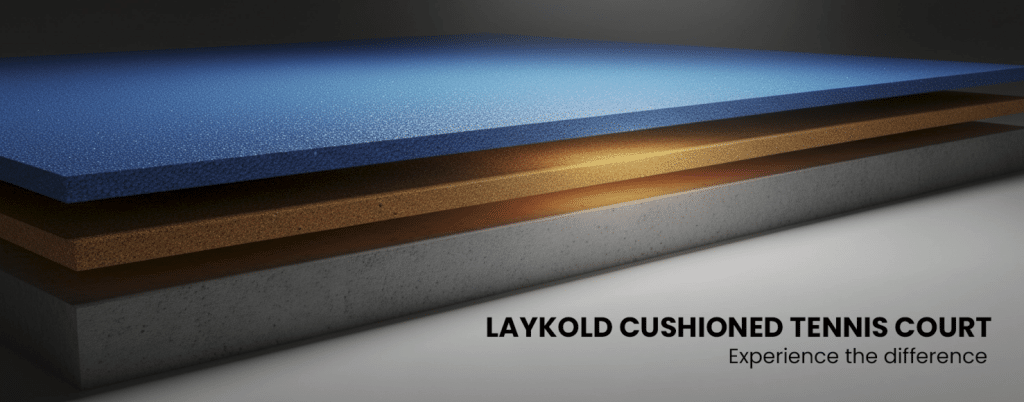
A cushioned tennis court adds one or more resilient layers between the hard base and the acrylic topcoat. That cushioning layer changes how force travels through the surface and back into the player’s body.
Players describe the feel as noticeably easier on the legs, with less fatigue, less joint stress, and more willingness to book another session the next day.
GameOn Turf supplies Laykold tennis court systems in New Zealand. Laykold is the official surface of the US Open, the Miami Open, and the WTA Finals. The reason those events trust it comes down to three things the surface consistently delivers: force reduction, energy return, and playing consistency.
The Laykold cushion range includes systems designed specifically for force reduction. Over 10 years, they retain 98% of their cushion resiliency, a meaningful difference from older cushion court technology, which loses its cushioning in two to three years.
Tennis club court surfaces that see plenty of players multiple sessions per week get the most value from a cushioned system. Body stress reduction isn’t just a comfort feature; it directly affects how often players can play and how they feel about your facility.
GameOn Turf’s Laykold range is also engineered for UV stability and colour retention, which matters in the New Zealand climate. Courts retain their appearance and performance throughout the seasons rather than fading or degrading prematurely.
For a home tennis court surface, cushioned acrylic gives you a professional-standard playing experience without the ongoing demands of clay or natural grass. It plays well with mixed abilities (family sessions, coaching, social games) and stays low maintenance once it’s in.
If you’re investing in a court at a high-end residential property, a Laykold tennis court system is the kind of installation that adds genuine value to the property, not just to your game.
| Hard / Acrylic | Cushioned Acrylic (Laykold) | Artificial Grass | Clay | Natural Grass | |
|---|---|---|---|---|---|
| Bounce and speed | Medium-fast, consistent | Medium-fast, consistent | Medium, consistent | Slow, high bounce | Fast, low bounce |
| Comfort underfoot | Firm | Noticeably softer | Moderate | Soft | Soft |
| Maintenance level | Low | Low | Low | High | Very high |
| All-weather use | Yes | Yes | Yes | Limited | No |
| Best for clubs | ✓ | ✓✓ | ✓ | Rarely practical | Not recommended |
| Best for homes | ✓ | ✓✓ | ✓✓ | Rarely practical | Not recommended |
| Resurfacing cycle | 4–8 years recoat | 4–8 years recoat | Replace pile at end of life | Ongoing | Ongoing |
| Lifespan potential | 15–20 years | 15–20 years | 10–15 years | Variable | Variable |
A club court faces a wide range of players, ages, and ability levels across hundreds of sessions a year. The surface needs to hold its performance characteristics under that load.
While both hard acrylic and Laykold cushioned systems are built for this, the cushioned option adds meaningful comfort benefits for your regular players.
Clubs running coaching programmes or targeting older player demographics should prioritise comfort more heavily. Laykold’s force reduction design is directly relevant here, making it the choice of major events that see high intensity of play.
The upfront cost is real, but so is the cost of tennis court resurfacing earlier than necessary because the base or surface weren’t specified correctly. A well-built Laykold tennis court system, installed correctly on a properly prepared base with good drainage, should deliver 15 to 20 years of performance before any major work is needed.
Most homeowners want a court that stays in good shape without becoming a project. Hard acrylic and synthetic grass are both honest answers here, as neither asks much of you week to week.
A competitive player in the household puts different demands on a surface than a family using it casually twice a week. If there’s a serious player involved, a cushioned tennis court makes sense. If it’s primarily recreational, a low maintenance tennis court in either acrylic or synthetic grass works well.
A well-designed and properly surfaced court adds measurable value to a premium property. The consistent surface texture and finish of a Laykold system are significantly better than that of a basic asphalt job.
If the court is part of a broader property investment, specify it accordingly.
New Zealand’s weather is variable. Courts in NZ need to handle rain, UV, and temperature swings without deteriorating quickly or becoming unplayable between sessions. Laykold systems are specifically engineered for UV stability and moisture control in Australian and New Zealand conditions, with the colour retention to match.
An all-weather tennis court isn’t just a marketing term here. It’s a practical requirement for any court that’s going to get regular use year-round.
The best tennis court surfacing NZ projects we’ve been involved with share one thing: they got the base right. Proper grading, appropriate sub-base depth, and well-designed drainage protect the surface above them. Courts that crack early, pond water, or shift under load almost always trace back to base issues, not surface failure.
GameOn Turf handles earthworks and baseworks in-house, meaning the same team responsible for surface quality is also accountable for what lies beneath it. That continuity matters.
Premium tennis court surfaces in New Zealand, installed on a proper base and maintained sensibly, should typically deliver 15 to 20 years of reliable performance. That’s the benchmark GameOn Turf works to—backed by strong warranties and workmanship guarantees.
The focus on NZ tennis court installation quality over the lowest upfront cost is what separates courts that earn their value over time from those that disappoint within a few years.
GameOn Turf supplies and installs tennis court surfaces for clubs, schools, and homes across New Zealand. Our tennis offer is built around Laykold, the same system used at the US Open, Miami Open, and WTA Finals, specified and installed to perform in New Zealand conditions.
We handle everything in-house: consultation, earthworks, baseworks, surfacing, line marking, and ongoing maintenance. That means you’re dealing with one team that knows the full picture of your court from the ground up.
With over 100 years of combined experience in sports turf construction and management across our team, and our own plant and machinery on every project, we don’t subcontract the parts that matter.
Not sure which tennis court surface suits your club or home? We can assess your site, playing needs, and long-term goals and recommend the right system with confidence. Get in touch to start the conversation or view our portfolio of previous works.
The best tennis court surface for home depends on how the court will be used and how much maintenance you want to manage.
For a serious player or a premium property, a Laykold cushioned acrylic system gives you professional-quality performance and excellent longevity. For family or casual use where ease of ownership matters more, an artificial grass court or standard acrylic hard court are both practical, low-maintenance options.
The main tennis court surface types are: hard court (asphalt or concrete with an acrylic coating), cushioned acrylic court (with a resilient underlayer for force reduction), artificial grass tennis court (synthetic turf engineered for tennis), clay court (crushed aggregate, high maintenance), and natural grass (fast-playing but rarely practical for most clubs or homes).
Yes, when the product is specifically designed and rated for tennis play. An artificial grass tennis court using ITF-rated turf delivers consistent bounce and pace, holds up under regular use, and performs in all weather. The key is specifying the right product and ensuring the base and drainage are done properly.
Hard acrylic and cushioned acrylic systems are the most genuinely low maintenance tennis court options, requiring occasional cleaning and recoating every four to eight years.
Artificial grass is also low-maintenance in day-to-day terms, with no watering or mowing. Clay and natural grass require significantly more ongoing work and are rarely practical for most NZ buyers.
A cushioned tennis court, particularly the Laykold range, is the standout choice for body comfort. The force-reduction technology embedded in the cushion layer reduces impact on knees, ankles, and joints compared to a standard hard surface. This is why the Laykold system is trusted at the Grand Slam level, where court welfare for elite athletes is a serious consideration.
Lifespan depends on the material, base quality, drainage, and how well the court is maintained. Premium tennis court surfaces in New Zealand, installed correctly on a proper sub-base, should typically deliver 15 to 20 years of reliable performance. Laykold cushioned systems are specifically designed to retain their cushion resiliency over that time, unlike older systems that can lose cushioning within a few years.
Tennis court resurfacing (recoating the acrylic layer) is typically needed every four to eight years, depending on use intensity, and is a much lighter-touch process than full reconstruction.
SEO By 
