
You’ve got the space and the itch to practice. Now comes the big question: artificial golf green or natural greens?
It sounds simple, but the answer depends on how you plan to use it, how much time you’ve got, and what kind of golfer you are. A weekend putter with a bit of spare lawn in Tauranga has very different needs from a school in Wellington or a golf club in Otago looking to reduce groundskeeping costs.
Both options have real merit. But in New Zealand’s climate and lifestyle, they’re not equal for most people. We break it down so you can make a decision that you’ll be happy with.
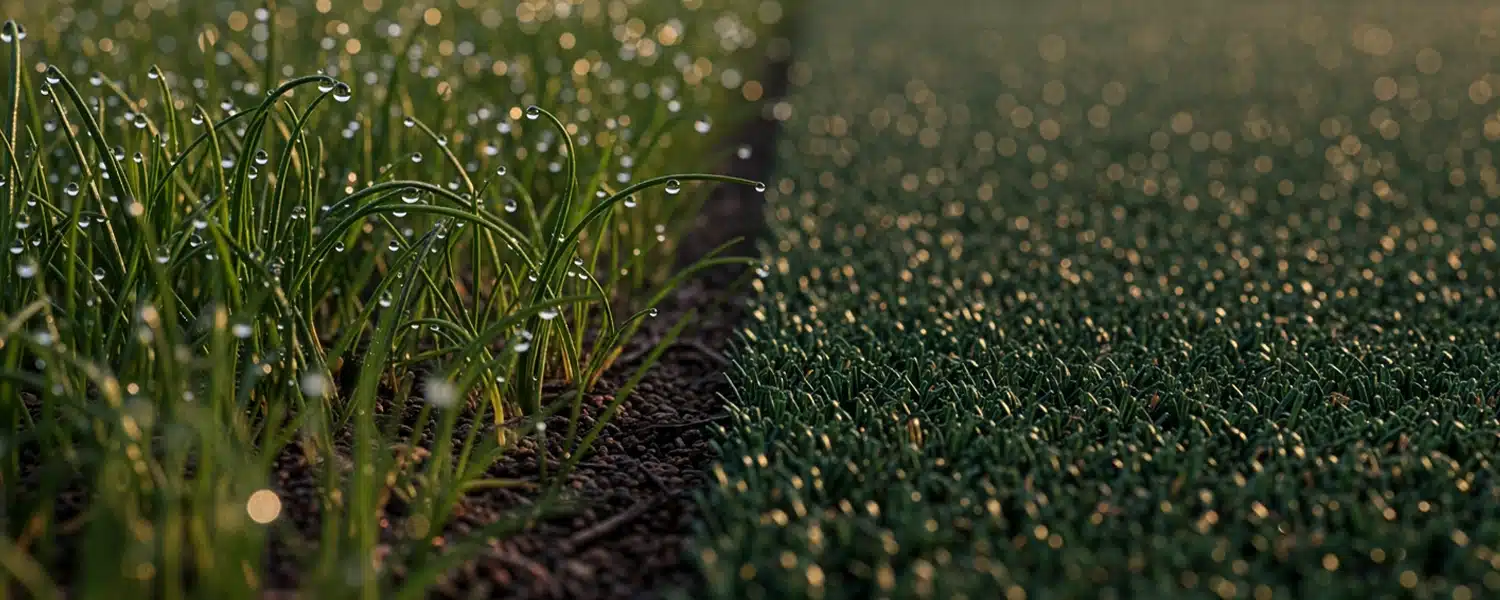
Natural putting greens are almost always grown using creeping bentgrass, a fine-bladed grass that tolerates very low mowing heights and produces a firm, fast surface. However, they must be properly maintained. Bentgrass needs to be cut to around 3–6mm, often daily, using a specialised reel mower. Add regular irrigation, fertilisation, aeration, and topdressing to that list. Miss a few steps, and the surface deteriorates quickly.
The practical difference comes down to consistency and commitment. A natural green can be spectacular under ideal conditions, while an artificial golf green delivers reliable performance from day one with a fraction of the ongoing effort.
An artificial putting green starts with earthworks—clearing, levelling, and compacting a solid base (usually crushed aggregate). A drainage layer goes in next, followed by the synthetic turf itself, which is precision-cut, seamed, and infilled with kiln-dried sand to control speed and surface firmness. Pile height typically sits between 13–16mm, with a fibre density much higher than standard synthetic grass in NZ. That’s what produces the smooth, consistent ball roll you’re after.
Premium products like SYNLawn Golf, which GameOn Turf supplies as the main New Zealand distributor, are built in collaboration with professionals who understand spin, roll, and short-game feedback. The SYNLawn Golf range can be calibrated to deliver a Stimpmeter reading between 10 and 12, covering the speed range you’d encounter on most course greens.
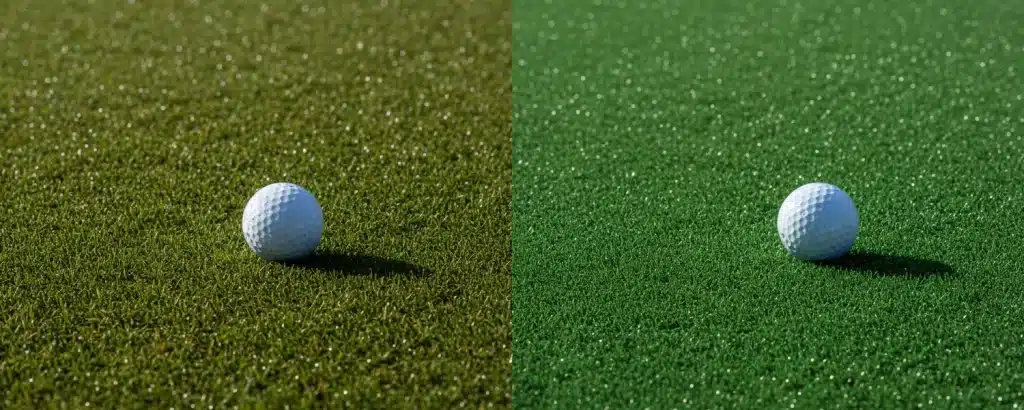
Natural greens offer something harder to replicate: the subtle, organic variability of real grass. Grain direction, moisture levels, and micro-undulations in the soil all affect how a putt behaves.
Competitive golfers argue that practising on natural grass better prepares you for on-course conditions, and that’s a fair point. But it cuts both ways: a natural green that’s slightly uneven or under-watered teaches bad habits just as easily as good ones.
Modern synthetic golf putting surfaces are purpose-built for true, repeatable ball roll. The short, dense, non-directional pile means the ball doesn’t grab, drift, or behave differently depending on where you’re putting from.
With no morning dew slowing things down and no afternoon heat drying the surface into inconsistency, you experience consistent speed throughout the day. For serious short-game work, that predictability is genuinely useful, allowing you to build muscle memory against a consistent baseline rather than compensating for surface variables.
For casual practice or daily home sessions, artificial wins on pure practicality as the surface is always ready and needs no preparation. For advanced short-game development, the gap has narrowed considerably. SYNLawn’s collaboration with coach Dave Pelz produced the Shot Stopper and Precision Putt products specifically to add realistic chipping response and green-speed control to synthetic surfaces.
Serious golfers use them seriously.
A bentgrass putting green at home requires daily mowing during the growing season with a specialised reel mower calibrated for sub-6mm heights. That’s a piece of equipment costing several thousand dollars that needs regular sharpening and adjustment.
On top of that, you will require dedicated irrigation (a garden hose won’t distribute water evenly enough), fertilisation every few weeks, aeration a few times per year, and topdressing to keep the surface smooth. Miss a hot dry spell and you could lose months of work in days.
Artificial greens aren’t completely maintenance-free but the difference is stark. A light brush every week or two to keep fibres upright, a quick leaf blower to clear debris, an occasional rinse in summer, and an infill top-up once or twice a year. That’s the full list. No watering, no mowing, no chemicals, no specialist equipment.
For a school with a groundskeeping team stretched across a full sports field, synthetic is simply more realistic. For a homeowner who’d rather be playing than mowing, it’s the obvious call. For a golf club adding a practice facility without doubling its maintenance budget, artificial is both practical and lowers ongoing cost across the lifetime of the installation.
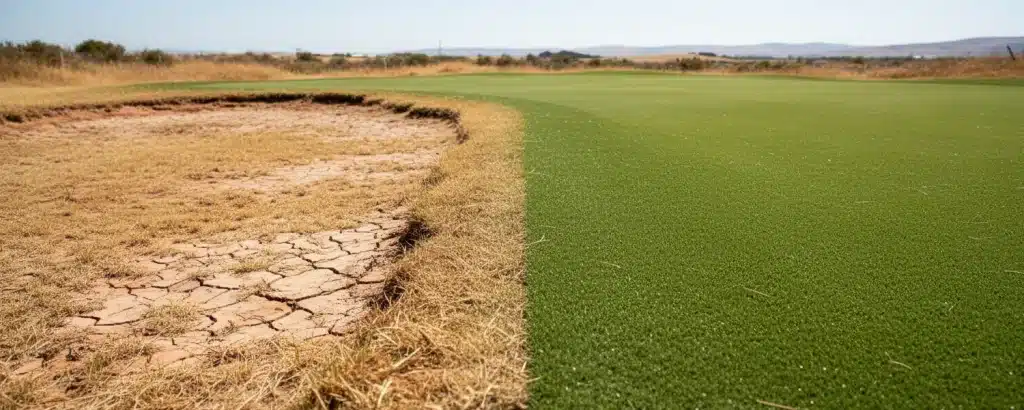
New Zealand’s weather is unpredictable, and natural greens feel it. Heavy winter rain saturates and softens the surface, creating soggy, unplayable conditions that can take days to recover from. Summer dry spells stress the grass, cause thin patches, and produce inconsistent surface speeds. Wind accelerates moisture loss, and shade from trees or structures prevents the even growth a good putting surface needs.
Managing a natural green through a full NZ seasonal cycle is a genuine challenge, even for experienced greenkeepers.
Synthetic turf handles our conditions well because it’s not dependent on climate to function. Quality artificial golf greens are built with fast-draining aggregate bases that shed water within minutes of heavy rain. The turf doesn’t absorb moisture or compact underfoot the way soil does, and UV-stabilised fibres hold up against the New Zealand sun without fading or breaking down.
The gap widens in regions where frost are common and growing seasons are short, like Queenstown, Otago, and Southland. A natural green in Central Otago is fighting the climate for six months of the year, while an artificial putting green simply isn’t.
Natural grass is vulnerable to concentrated foot traffic. Repeated footfall around the hole, practice divots from chipping and heavy summer use all take a toll. Worn patches recover slowly, and small home greens can’t rotate hole positions the way a course can. In some cases, sections need complete reseeding during the off-season.
Premium synthetic putting turf, particularly products built on nylon fibres with embossed backing, is designed for repeated use. Fibres resist flattening, the backing holds its shape, and infill maintains surface consistency even under heavy traffic. Most quality artificial putting greens carry manufacturer warranties of 8–15 years, and with basic care, they often outlast that.
If you’ve ever considered transforming your golf experience with artificial sports turf, the performance gains go well beyond just durability. Our team has seen well-installed synthetic greens still rolling true after 12 years of regular use—something very few home or school natural greens can match.
For commercial facilities, that durability translates directly into value. A synthetic green installed once, lightly maintained, and performing consistently for a decade is a better long-term investment than a natural green that requires constant intervention and periodic renovation.
Natural grass is cheaper upfront as bentgrass sod and basic earthworks cost less to start. However, that lower entry price is misleading when you account for what comes next. Specialist reel mowers alone run $3,000–$6,000+. Add regular fertilisation, pest control, aeration, irrigation, and the cost of repairing drought or disease damage, and the annual bill climbs quickly.
In New Zealand, synthetic grass installation typically runs between $180 and $450 per square metre, depending on turf quality, base preparation, and site access. Specialised putting green installations with custom contouring, multiple holes, fringe grass, and quality drainage sit toward the higher end of that range.
Artificial greens have essentially zero ongoing input costs beyond the occasional bag of infill and a light brush. Over a 10-year period, they almost always work out cheaper in total, and commercial facilities can save further on staff hours.
Modern synthetic putting surfaces look very different from the plastic, shiny fake grass of 20 years ago. Today’s turf uses realistic colour variation, non-directional fibre orientation, and natural-looking fringe grass around the perimeter. When the base is properly shaped and edges are well-finished, most people genuinely can’t tell the difference at a glance.
Some golfers simply prefer the look of real grass—from the subtle colour variation, to the texture underfoot and the smell of cut grass on a warm morning. If you’re building a statement piece at a premium property and have the resources to maintain it properly, the aesthetic can be worth it.
The quality of an artificial green’s appearance comes down to installation more than anything else. Precise earthworks, well-shaped contours, clean edging, and a quality fringe border all matter.
Our team uses CAD design before earthworks begin, so you can see the finished shape and contours before a single turf roll is laid.
For home use, artificial is the better choice for the overwhelming majority of homeowners. It’s playable every day of the year, needs no specialist upkeep, and can be designed to suit your space, whether that’s a compact 25m² flat green or a contoured 80m² short-game area with a chipping fringe.
For schools and training facilities, synthetic fits the brief perfectly. It handles heavy student foot traffic, requires no specialist equipment to maintain, and stays consistent through the school year regardless of weather.
For golf clubs and high-use spaces, artificial is often the most practical choice for a dedicated practice area. It gives members a consistent surface without adding to the groundskeeping workload, and at a 10–12 Stimpmeter rating it delivers a realistic practice environment that transfers well to on-course play.
Some golfers genuinely prefer practising on real grass. This is particularly so for competitive players who want to read grain, feel surface variation, and replicate on-course conditions as closely as possible. If that matters to you and you’re prepared to commit to the maintenance, a bentgrass green can be a fantastic asset.
High-end properties or golf complexes with existing groundskeeping staff can absorb the maintenance demand without much difficulty.
If you already have irrigation infrastructure, specialised mowing equipment, and experienced staff, the additional burden of a natural putting green is manageable.
For premium estates where the natural environment is central to the experience, a natural green can be part of a larger design statement. Just go in with clear eyes about what that commitment requires.
The single biggest driver is consistency with minimum effort. A surface that plays the same every day, in every season, without a demanding maintenance routine is perfect for anyone balancing work, family, and their love of golf.
If you’re still weighing up the options, our guide on why fake grass makes sense for putting greens in NZ breaks down exactly why so many Kiwi golfers are making the switch.
New Zealand weather rarely cooperates with finicky natural surfaces. Artificial greens handle rain, wind, heat, and frosts without missing a beat. The surface recovers within minutes of heavy rain, and there’s no wet-weather damage to repair come spring.
For a broader look at how the two surfaces compare on New Zealand properties specifically, our natural grass vs artificial turf in NZ guide covers the full picture.
Artificial golf greens are more versatile than most people expect. They work on rooftops, indoor spaces, courtyard areas, and sloped sections that natural grass couldn’t tolerate.
We’ve installed synthetic golf surfaces on lifestyle blocks in Waikato, school grounds in Auckland, and premium residential properties across the North Island. The brief is different every time, but the outcome is always the same: a surface people actually use.
If you want a surface you can practise on year-round without specialist equipment or a weekly maintenance routine, artificial is the right choice. It’s the practical option for homes, schools, sports facilities, and clubs. With modern turf technology, it delivers genuine short-game performance.
If you’re a golf purist who values the authenticity of real grass, has the budget for proper installation and ongoing care, and genuinely enjoys the process of maintaining a natural surface, a bentgrass green can be exceptional.
The answers will usually point you in a clear direction.
GameOn Turf is New Zealand’s main supplier of SYNLawn Golf products. Our team designs, builds, and installs artificial golf surfaces for homes, schools, and clubs, handling everything in-house from CAD design and earthworks through to installation and finishing.
Get in touch with our team to discuss your space and get a no-pressure quote.
Yes, especially when you choose a product engineered for golf rather than general synthetic grass in NZ. High-stitch-rate putting turf, paired with the right infill and properly calibrated installation, delivers ball roll, speed, and surface response that transfers well to on-course conditions.
SYNLawn Golf products are built specifically for serious golfers, not just casual putters.
Not exactly the same, but closer than most people expect until they try one. Modern putting turf is firm underfoot, and ball roll is smooth and consistent, allowing most golfers to adapt quickly.
The main difference is the organic variability of natural grass, like grain direction and moisture changes, which synthetic surfaces don’t replicate. Whether that’s a drawback depends entirely on what you’re practising for.
In most cases, yes, significantly so. Daily mowing with specialised equipment, dedicated irrigation, regular fertilisation, pest and disease management, and periodic aeration all add up fast.
A natural putting green can easily cost several thousand dollars per year to maintain properly. An artificial green’s annual upkeep is essentially just a light brush and the occasional infill top-up.
Quality artificial putting greens typically last 10–15 years with regular light maintenance. Premium products with UV-stabilised fibres and robust backing systems can outlast that, particularly in covered or sheltered installations.
GameOn Turf’s exact warranty length depends on the turf system and application. Ask us for the specific warranty that applies to your chosen turf product and installation.
Artificial turf performs considerably better than natural grass in most regions of New Zealand. Fast-draining aggregate bases shed water quickly after rain, the turf itself isn’t damaged by frosts or dry periods, and UV-stabilised fibres hold up against the New Zealand sun.
In areas like Canterbury, Otago, and Southland, where growing seasons are short and frosts are common, artificial is the year-round practical choice.
SEO By 
